
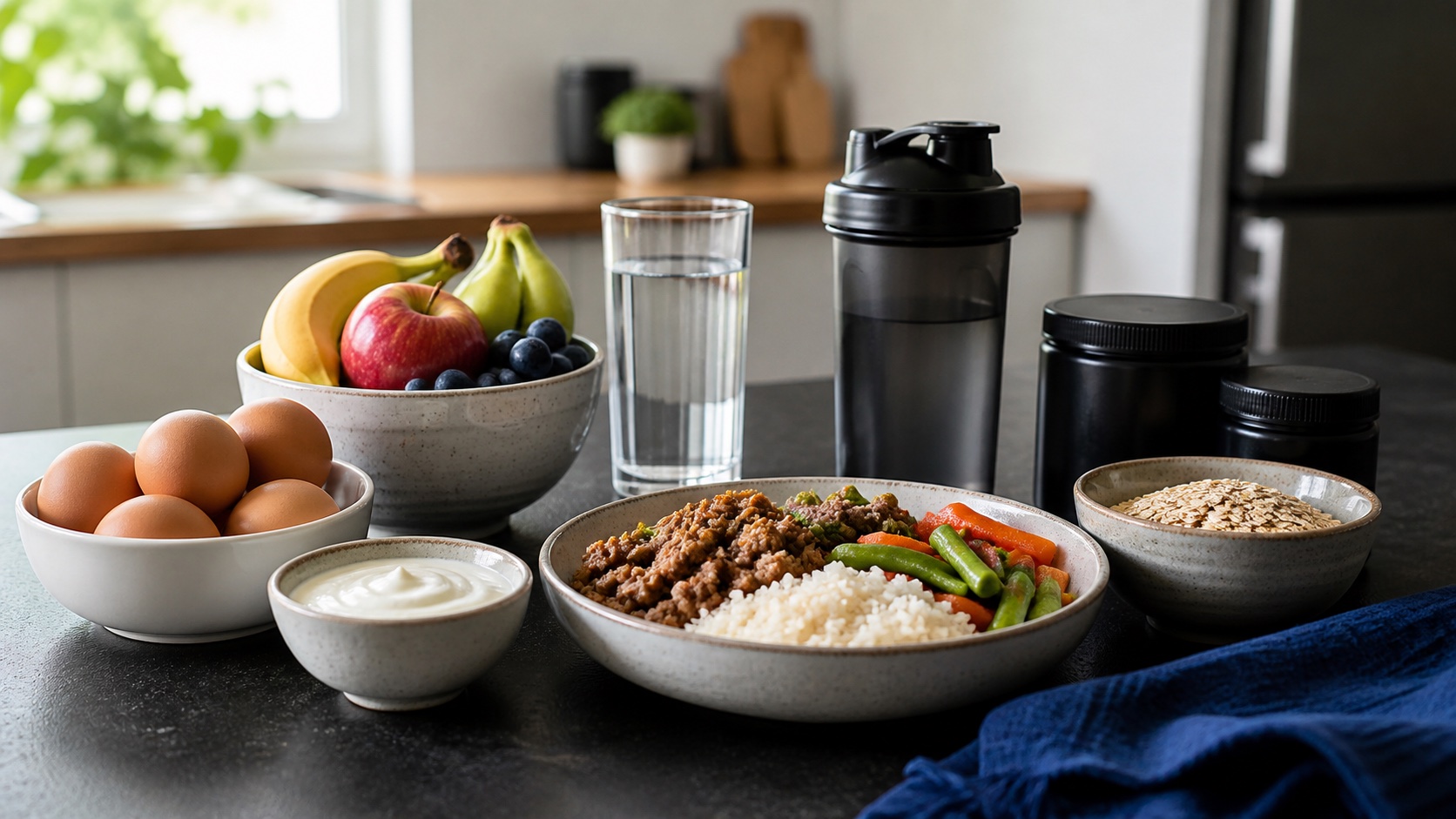
The short answer is no.
You can build muscle, lose fat and become much stronger without owning a single tub of powder. A supplement can make part of the process easier, but it cannot replace a useful training program, enough protein, an appropriate calorie intake, decent sleep and months of consistent work.
I want to be upfront about that because the original video attached to this article showed almost everything I was eating and taking during a focused physique phase. There was a lot on the bench.
Some of it still makes sense. Some of it was a personal experiment. And some of the claims I made were more confident than the evidence justified.
The most useful part of that video was never the size of the supplement stack. It was the system underneath it.
Video note: The original video shows what I personally used at that time. This article contains my current evidence-informed guidance and supersedes any general supplement, dosage or health claims made in the video.
Start with the part that actually changes your body
When I want to change my physique, my food becomes very simple.
In the video, I showed a large batch of kangaroo mince that I could portion with microwave rice and turn into a meal in about 90 seconds. I used the same herbs, garlic and chilli sauce regularly. I rotated a small number of protein sources. None of it was glamorous.
That was the point.
The fewer decisions I had to make when I was busy or hungry, the easier it was to follow the plan. Repeating meals is not physiologically superior to eating a varied menu. It was a practical preference that suited me.
It also is not the right setup for everyone. Some people need more variety to stay consistent. Most people would benefit from more vegetables, legumes, fruit and wholegrains than I showed in that video. A plan only works if it covers your health needs and fits the person living it.
Before you buy a supplement, get these parts reasonably solid:
- a training plan that matches your goal and progresses over time;
- an energy intake that supports fat loss, maintenance or muscle gain;
- enough protein across the day;
- enough vegetables, fruit, fibre and other nutrient-dense foods;
- sleep and recovery you can realistically repeat; and
- a routine that still works on your busy days.
If those pieces are missing, the next powder is rarely the answer.
How much protein do you need?
Protein matters for muscle repair and growth, but more is not automatically better.
The Australian Institute of Sport gives a range of about 1.2–1.6 grams of protein per kilogram of body weight per day for athletes in heavy training, with higher ranges used in some weight-loss phases where preserving muscle is a priority. A large meta-analysis also found that the average benefit for resistance-training gains levelled off around 1.6 g/kg/day, although individual needs and dieting contexts vary.
In my coaching, I often use roughly 2 g/kg/day as a practical higher-protein target where it is appropriate. That is a coaching preference, not a universal scientific minimum. Body size, current body composition, diet, training load, health, food tolerance and the goal all matter.
You can reach your target with normal food. A protein powder is simply one convenient way to close the gap.
The supplements that can earn a place
1. Protein powder: useful, not essential
Whey, casein, soy and other quality protein powders can help when another full meal is inconvenient or pushes calories beyond what your plan allows.
That is why I used a shake. I could add a useful serve of protein quickly without cooking another steak or carrying a meal around.
A shake does not burn fat. It does not outperform a good diet when total protein is already sufficient. It is just an easy protein source.
When comparing products, look at the protein per serve, the full ingredient list, allergens, taste, price and whether you actually need it. The front of the tub is advertising. The back tells you what you are buying.
2. Creatine monohydrate: the clearest general performance option
If a healthy adult who lifts weights asks me which gym supplement has the strongest case, creatine monohydrate is near the top.
Creatine helps replenish energy for short, high-intensity efforts. Used consistently alongside resistance training, it can support strength, training quality and gains in lean mass. The AIS classifies creatine as a Group A performance supplement for specific sporting situations.
A simple maintenance approach is 3–5 g of creatine monohydrate daily. Loading can saturate the muscles faster, but it is optional. You also do not need to panic about a tiny pre- or post-workout window. Consistent intake matters more than placing the scoop beside your final rep.
Creatine can increase scale weight because it draws more water into muscle. That is not the same as gaining body fat. Some people also experience stomach upset, particularly with larger doses.
If you have kidney disease, another relevant medical condition, take medication that may interact, are pregnant or breastfeeding, or are unsure whether it suits you, speak with your doctor or pharmacist first.
3. Caffeine or pre-workout: optional help for a session
Caffeine can improve performance and reduce how hard an effort feels. The AIS reports that relatively small doses—around 2–3 mg/kg—can be effective, but people respond very differently.
More is not better.
If caffeine leaves you anxious, gives you a racing heart or damages your sleep, the trade-off may be terrible even if the workout felt better. Check the total from coffee, energy drinks, fat burners and pre-workouts rather than treating every product as a separate drink.
A coffee may do the same job as an expensive pre-workout. For me, the drink also became part of the ritual that said, “I am training now.” That routine effect is real as a personal coaching observation. It does not mean every ingredient in a colourful blend improves performance.
Use the lowest amount that does the job, avoid pure or highly concentrated caffeine powders and protect your sleep.
Supplements that depend on a real need
This is where the answer stops being “everyone should take it”.
Vitamin D
Vitamin D matters, and people who train indoors, have limited sun exposure, have darker skin or live in southern parts of Australia may have a higher risk of low levels. That still does not make one high-dose routine correct for everybody.
The right approach is to consider your risk factors and get medical advice or testing where appropriate. If a deficiency is identified, the treatment dose and follow-up should match the person. I would not now publish the fixed high-dose routine from the original video as general advice.
Magnesium
Magnesium is involved in many normal body processes, but that does not mean everybody will feel better from a supplement.
Start with food sources such as nuts, seeds, legumes, wholegrains and leafy vegetables. If you are considering a supplement, check the amount of elemental magnesium rather than only the compound named on the front. Australia's current upper level for magnesium from supplements is 350 mg/day for adults, mainly because higher supplemental intakes can cause diarrhoea. That upper level does not include magnesium naturally present in food.
Omega-3
The Heart Foundation recommends Australian adults aim for two to three serves of fish a week, including oily fish. For people without heart disease, the evidence for routine omega-3 supplements is less consistent.
If you do not eat fish or seafood, a fish or algae oil may provide EPA and DHA. If a health professional recommends one for a clinical reason, follow that advice. Either way, compare the actual EPA and DHA on the label—not just a large “fish oil” number on the front.
Fibre
Fibre helps normal gut function and is part of a healthy dietary pattern. Australian adequate intakes are 25 g/day for adult women and 30 g/day for adult men.
Food is the first option: vegetables, fruit, legumes, wholegrains, nuts and seeds bring more than isolated fibre. A supplement may be useful in some circumstances, but increase fibre gradually and drink enough fluid. If bloating, reflux, constipation or other digestive symptoms persist, do not keep adding random enzymes and powders. Speak with a GP or Accredited Practising Dietitian and work out what is actually going on.
Multivitamins and other nutrients
A multivitamin can have a role when a restricted diet, life stage, diagnosed deficiency or professional recommendation creates a clear reason. It is not insurance against a poor diet, and stacking several fortified products can push the same nutrient higher than you realise.
What I would not recommend as a default
Fat burners
Fat burners are usually a mixture of stimulants, herbs and impressive claims.
They do not replace an energy deficit. The US National Institutes of Health's Office of Dietary Supplements concludes that there is little scientific evidence that weight-loss supplements work. Even where an ingredient produces a small effect in a study, that does not prove a multi-ingredient product will produce a meaningful result for you.
The old claim that acetyl-L-carnitine would deliver a five per cent advantage was not justified. I would not use it now as a promise.
“Hormone”, “cortisol”, “growth hormone” and “insulin” products
I experimented with products marketed around growth hormone, cortisol, estrogen, testosterone and glucose handling. Feeling different after taking something is not proof that it changed a hormone in a useful or safe way.
Hormones are not a physique dial to turn casually. Low estrogen is not automatically better for men. Poor sleep is not automatically a cortisol disorder. Bloating is not proof that you need more digestive enzymes. If you have symptoms that suggest a hormonal, metabolic or digestive problem, that is a health conversation—not a supplement-stack conversation.
Greens powders
A greens powder can be an occasional backup if convenience is the only alternative to nothing. It is not a replacement for varied vegetables, fruit, legumes and wholegrains. Whole foods bring fibre, volume and a complex mix of nutrients that a scoop does not reproduce.
I understand the practical problem because I said plainly in the video that I did not enjoy cooking vegetables. The answer is to make vegetables easier—frozen options, bagged salad, pre-cut produce, roasting a tray at once—not to pretend the green powder has made the rest irrelevant.
Lemon water, apple cider vinegar and extra salt
If lemon water helps you drink more water or start the day with a useful routine, fine. If vinegar makes a meal taste better, use it. Those are preferences, not fat-loss requirements.
They do not need to be sold as immune boosters, stomach-acid fixes or glucose-partitioning tools.
Sodium is essential and targeted electrolyte replacement can matter during prolonged training, hot conditions or high sweat losses. That does not mean everybody should add extra salt to everything. The context matters.
How to judge any supplement in six questions
Before you spend the money, ask:
- What exact problem am I solving? “Getting healthier” is too vague.
- Have I fixed the bigger gap first? Training, calories, protein, food quality, sleep and adherence usually matter more.
- Is there good human evidence for my goal? Not only a mechanism, animal study, podcast or company-funded before-and-after.
- Does the product contain the studied ingredient at a useful dose? A long ingredient list can hide very small amounts.
- What are the side effects, interactions and reasons I should not take it? Ask a doctor, pharmacist or Accredited Practising Dietitian when health conditions, medication, pregnancy or symptoms are involved.
- If I compete, is the exact batch independently tested? “Natural” and “sold in Australia” do not guarantee a product is free of substances banned in sport.
In Australia, many low-risk complementary medicines with an AUST L number are listed on the Australian Register of Therapeutic Goods without the TGA individually evaluating the product before sale. If you compete, use the Sport Integrity Australia app to check the exact product and batch. Batch testing lowers risk; it does not remove it completely.
My honest supplement hierarchy
For most healthy adults training in the gym, my order is simple:
- Build the base: training, energy intake, protein, varied food, fibre, sleep and consistency.
- Add convenience if you need it: protein powder can make the plan easier.
- Add a proven performance tool if it suits the goal: creatine monohydrate has the clearest general case; caffeine is optional.
- Use targeted health supplements for a defined reason: assessment, diet, symptoms, testing and professional advice should guide vitamin D, magnesium, omega-3 and similar products.
- Make everything else earn its place: if the benefit is vague, the evidence is weak or the stack is doing more work than your training plan, save your money.
I am not anti-supplement. I am anti pretending the small things are the main things.
Get the base right. Use a supplement when it makes that base easier or produces a specific, evidence-backed benefit. Then keep checking whether it still deserves a place.
If you are tired of guessing and want help building a training and nutrition plan around your real life, tell me where you are at and what you are trying to change. We can start with a straightforward conversation.
This article provides general fitness and nutrition education. It does not diagnose or treat a medical condition and is not a substitute for individual medical or dietetic advice.
Evidence links for the published article
- Australian Institute of Sport: Group A supplements (opens in a new tab)
- Australian Institute of Sport: isolated protein supplements (opens in a new tab)
- Morton et al.: protein supplementation and resistance training meta-analysis (opens in a new tab)
- Australian Institute of Sport: creatine (opens in a new tab)
- Australian Institute of Sport: caffeine (opens in a new tab)
- Australian Institute of Sport: vitamin D (opens in a new tab)
- Eat For Health: magnesium nutrient reference values (opens in a new tab)
- Eat For Health: dietary fibre nutrient reference values (opens in a new tab)
- NHMRC: Australian and New Zealand Nutrient Reference Values (opens in a new tab)
- Heart Foundation: fish and omega-3 questions and answers (opens in a new tab)
- NIH Office of Dietary Supplements: weight-loss supplements (opens in a new tab)
- TGA: listed and registered complementary medicines (opens in a new tab)
- Sport Integrity Australia: supplements in sport (opens in a new tab)