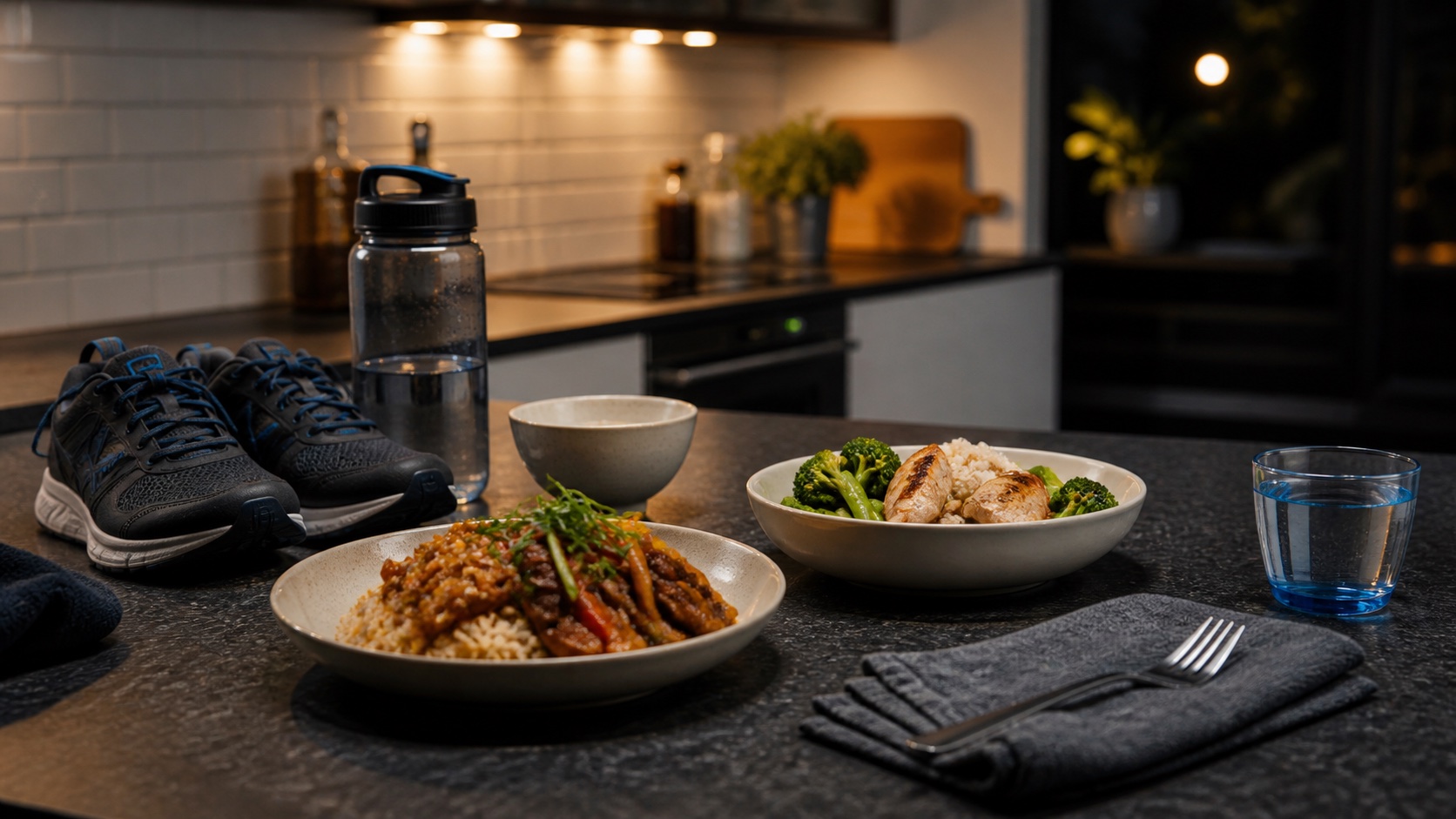
One workout cannot cancel a weekend of eating.
One pizza cannot cancel a month of training either.
That is the useful answer behind the old line that you cannot out-train a bad diet.
I recorded the original conversation behind this article with dietitians and physique coaches Jack and Tyarra while I was out on a morning walk in 2020. We talked about lockdowns, home training, macros, protein and gut health. The circumstances have dated. The questions have not.
Can I eat what I want if I train hard enough? Do I need to track every gram? How much protein do I actually need? Does a healthy diet have to be perfect?
No. Your diet does not have to be perfect.
But it does have to make sense beside the result you want.
The quick answer
At the level of energy balance, a highly active person can expend enough energy to offset a high intake. That is why “you can never out-train a bad diet” is not literally true in every mathematical scenario.
For most people, it is still a poor strategy.
If fat loss is the goal, you need a sustained energy deficit over time. Training contributes to the energy you use, but creating the entire deficit through more exercise can demand far more time and effort than most people can repeat. Your body weight also changes dynamically as intake, activity and body composition change; it is not a fixed calories-in/calories-out calculator. The NIDDK Body Weight Planner (opens in a new tab) is built around that dynamic relationship.
For a complete explanation of the deficit, normal scale fluctuations and how resistance training fits, use the free KZPT Fat Loss Fundamentals guide.
Training remains valuable even when fat loss is not happening. It can improve strength, fitness, physical function and health. Australia's current movement guidelines recommend activity across the week, including muscle-strengthening work on at least two days for adults—not merely exercise performed to burn off food. (Australian Government movement guidelines (opens in a new tab))
The better rule is this:
Do not use training to pay for food. Use training and nutrition together to support the goal.
What does a “bad diet” actually mean?
I do not like labelling individual foods as good or bad. It turns nutrition into a moral test and rarely helps someone make a better decision.
A cookie is not a bad diet. Neither is a hot cross bun, a restaurant meal or some ice cream.
The problem is normally the wider pattern:
- your average energy intake does not match your fat-loss, maintenance or muscle-gain goal;
- protein is consistently too low for your training and circumstances;
- fruit, vegetables, wholegrains, legumes, nuts and seeds rarely make it into the week;
- most meals are improvised, so snacks and extras quietly become the main structure; or
- the plan is so rigid that you cannot repeat it in real life.
Food quality and energy density are also different ideas.
Avocado, nuts, peanut butter, hummus and olive oil can all contribute useful nutrients. They also contain a meaningful amount of energy. That is not a reason to fear them. It is a reason to understand the portion when body-weight change matters.
On the other side, a lower-kilojoule food is not automatically nutritious or filling.
You need enough perspective to see the whole diet, not only whether one food looks “clean”.
Nutrition and training have different jobs
They overlap, but they are not interchangeable.
| Goal | Nutrition's main job | Training's main job |
|---|---|---|
| Fat loss | Create a sustainable energy deficit while supplying enough protein and nutritious food | Preserve or build physical capacity, support muscle and add useful activity |
| Muscle gain | Supply enough energy, protein and nutrients to recover and grow | Provide the progressive resistance-training stimulus that tells the body to adapt |
| General health | Provide a varied eating pattern that covers energy and nutrient needs | Improve fitness, strength, function and health while reducing sedentary time |
For fat loss, food intake is usually the easiest side of the equation to control. That does not make exercise optional for health or muscle. It means an extra workout should not become your punishment for eating.
For muscle gain, eating more without progressive training does not guarantee that the extra weight will be muscle. The training creates the reason to adapt. Food supports the work.
That distinction is simple, but it clears up a lot of confusion.
Do you need to track calories?
Not everyone needs to track. Not everyone benefits from avoiding it either.
The amount of precision should match the goal, the person and the phase of life.
Option 1: use meal structure without numbers
For someone who wants better general habits or gradual progress, a simple plate structure can be enough to start:
- make roughly half the meal colourful vegetables or salad;
- include a useful serve of protein;
- add a carbohydrate source that suits your training, appetite and goal; and
- include a normal portion of dietary fat where it fits.
That is a practical coaching template, not a scientific law. Your breakfast may not look like a dinner plate. Fruit, dairy or alternatives and snacks may sit outside it. The point is to build actual meals instead of grazing through the day and hoping it adds up.
Option 2: track the part you need to learn
You might track protein, a few calorie-dense extras or your normal portions for a short period.
This can be useful when your usual “tablespoon” of peanut butter is much larger than the serving you had in mind, or when cooking oil, drinks and snacks keep disappearing from your mental tally.
The purpose is calibration, not catching yourself doing something wrong.
Option 3: track the full day for a defined reason
If you want a more predictable fat-loss phase or you are preparing for a physique goal, full calorie and macronutrient tracking can provide useful information.
Digital dietary self-monitoring can support weight-loss interventions, especially when it is paired with tailored feedback. It is a tool, not the result by itself. (Berry and colleagues, 2021 (opens in a new tab))
As a bodybuilder and coach, I know what high precision can achieve. I also know it costs time and headspace. Competition-level control should not be the default expectation for someone who wants to lose a bit of the belly, feel stronger and enjoy normal weekends.
A short, accurate tracking phase can teach you a lot. Permanent tracking is not a badge of discipline.
If tracking increases anxiety, guilt, rigid food rules, compensatory exercise or fear of eating socially, step back and get appropriate support. The WA Centre for Clinical Interventions specifically identifies using exercise to “earn” food and an obsessive focus on calorie counting as eating-disorder warning territory. (CCI guidance on counting calories (opens in a new tab))
How much protein do you actually need?
Protein is where general health advice and physique advice are often mixed together.
Australia's Nutrient Reference Values set the adult recommended dietary intake at 0.84 grams per kilogram per day for men aged 19–70 and 0.75 grams per kilogram for women aged 19–70. Those values are designed to meet the needs of almost all healthy people in the group. They are not muscle-building targets for every person who lifts weights. (NHMRC Nutrient Reference Values (opens in a new tab))
For healthy adults doing resistance training, a large meta-analysis found that protein supplementation improved gains in muscle and strength, with the average additional muscle-building benefit levelling off around 1.6 grams per kilogram per day. The upper end of the confidence interval was about 2.2 grams per kilogram, which is one reason sports-nutrition ranges often extend higher. (Morton and colleagues, 2018 (opens in a new tab))
My normal KZPT coaching preference is to start many suitable resistance-training clients around 1.6 to 2 grams per kilogram of body weight per day, then adjust for body size, diet, health, training, tolerance and goal.
That is a practical starting range. It is not a universal minimum.
For a 60-kilogram lifter, 1.6 to 2 grams per kilogram works out to 96–120 grams per day. Spread across four meals, that is roughly 24–30 grams per meal.
You do not have to hit the same number at every meal, and total daily intake matters more than forcing a perfect distribution. Spreading protein across three or four useful servings is simply an easy way to reach the day without discovering at dinner that nearly all of it is still missing.
The much higher recommendation mentioned in the original conversation—2.3 to 3.1 grams per kilogram—is based on fat-free mass, not total body weight, and applies to lean, resistance-trained athletes dieting under energy restriction. It should not be copied as a general target for every gym member. (Helms and colleagues, 2014 (opens in a new tab))
If you have kidney disease, a medical condition affecting nutrition, are pregnant, have a history of disordered eating or are unsure whether a high-protein target suits you, get individual advice from an appropriate health professional.
Is whey better than eggs, chicken, beef or plant protein?
There is no single protein source that wins every meal.
Whey is convenient and rich in essential amino acids. Dairy foods can contribute calcium. Eggs provide protein alongside nutrients such as choline. Lean meat can contribute iron and zinc. Oily fish provides protein and long-chain omega-3 fats. Legumes, tofu, tempeh, wholegrains, nuts and seeds can contribute protein alongside fibre and other nutrients.
The useful principle from the original conversation was variety. Different foods bring different things to the diet.
The part I would update is the claim that someone eating plant protein must carefully pair foods at each meal or supplement essential amino acids to build muscle. A well-planned plant-based diet can support resistance-training adaptations when total protein and the wider diet are adequate. In a 2023 clinical trial, high-protein omnivorous and non-animal diets supported similar muscle protein synthesis, lean-mass and strength responses during resistance training. (Monteyne and colleagues, 2023 (opens in a new tab))
Plant-based eating can still require deliberate planning, particularly for protein quantity and nutrients such as vitamin B12, iron, iodine, calcium and omega-3 fats. That is different from saying plant protein does not work.
What about gut health and “30 plants a week”?
More plant variety is a useful goal. Thirty is not a magic pass mark.
The popular “30 plants a week” idea came from the American Gut Project. Researchers compared self-selected participants who reported eating more than 30 types of plants with those reporting fewer than 10 and found differences in their gut microbiomes and metabolites. It was a large and interesting citizen-science project, but it was observational. It did not prove that reaching exactly 30 causes better health or that 29 is inadequate. (McDonald and colleagues, 2018 (opens in a new tab))
Use 30 as an optional game if it makes your diet more varied. Do not turn it into another rule to fail.
The stronger starting point is the Australian guidance to eat a wide variety from the five food groups. General adult guidance includes at least five serves of vegetables and legumes or beans and two serves of fruit a day, with individual needs varying. (Australian Government healthy-eating guidance (opens in a new tab))
In practice, variety can come from fruit, vegetables, legumes, wholegrains, nuts, seeds, herbs and spices across the week. Frozen, tinned and fresh foods can all help.
If increasing fibre causes discomfort, change it gradually rather than trying to jump from very little to 30 different plants overnight. If you have persistent bloating, pain, bowel changes or suspected intolerances, do not diagnose yourself from a food list and remove whole categories indefinitely. Speak with your GP or an Accredited Practising Dietitian.
Do you need fat with vegetables and vitamins?
Vitamins A, D, E and K are fat-soluble, and dietary fat can help the absorption of fat-soluble compounds such as carotenoids.
That does not create a universal rule that every vegetable meal needs exactly 10 grams of added fat.
In a small crossover study, seven people absorbed more carotenoids from a salad eaten with 6 or 28 grams of canola oil than from the same salad with fat-free dressing. The study supports including some fat with a very low-fat vegetable meal, but it does not establish one perfect number for everybody. (Brown and colleagues, 2004 (opens in a new tab))
The practical answer is easy: include a normal fat source such as olive oil, nuts, seeds, avocado, eggs or oily fish where it suits the meal. If the meal already contains fat, you do not need to add more simply to chase absorption.
Vitamin D deficiency and supplementation need more care than a general food article can provide. Follow the product directions and advice from your GP, pharmacist or dietitian rather than copying a large dose from a podcast or social post.
A practical reset for the next seven days
Do not rebuild your entire diet tonight. Start with the highest-value change.
- Name the goal. Fat loss, weight maintenance, muscle gain and general health do not require identical eating.
- Keep training. Train for strength, fitness, skill and health—not to erase a meal.
- Choose the least tracking that gives you useful information. That may be no numbers, protein only, a short portion audit or a fully tracked phase.
- Anchor your main meals. Include a useful protein source and at least one plant food, then add carbohydrate and fat to suit the goal.
- Make the easy-to-miss extras visible. Oils, sauces, drinks, snacks and weekend portions count without being morally bad.
- Review the pattern, not one day. Use several weeks of body-weight trend, training performance, appetite, energy and adherence before changing everything.
- Adjust one thing. A smaller portion, a planned snack, an extra protein serve or a better lunch structure is easier to assess than a complete overhaul.
If you are not sure whether training, nutrition, recovery or consistency is the biggest gap, the free KZPT Fitness Score gives you a practical place to start.
Evidence-backed guidance versus my coaching preference
Here is the clean distinction.
The evidence supports:
- body-weight change is governed by energy intake and expenditure over time, with real biological adaptation rather than a perfectly static equation;
- physical activity has health and fitness benefits even when it produces little or no weight loss;
- adequate protein supports resistance-training adaptation;
- a varied diet built around nutritious foods matters beyond the calorie total;
- plant-based diets can support muscle gain when they are properly planned; and
- plant variety is associated with microbiome differences, but exactly 30 plants is not an established clinical requirement.
My practical KZPT starting point is:
- use three or four anchored meals rather than relying on unplanned grazing;
- start many suitable lifters around 1.6–2 grams of protein per kilogram, then individualise it;
- use a short, high-accuracy tracking phase when the extra information will improve a decision;
- keep enjoyable foods in the plan in amounts the goal can support; and
- ask for more precision only when the desired outcome genuinely requires it.
The first list describes the evidence base. The second is how I often turn it into a workable first step. Your health, training history, relationship with food and actual goal may call for something different.
The takeaway
You do not need to eat like a bodybuilder to benefit from the gym.
You do need an eating pattern that supports what you are asking your body to do.
Training hard cannot supply the protein, fibre and micronutrients missing from the rest of the week. Nutrition cannot replace the training stimulus that builds strength and muscle.
Bodybuilding taught me that precision works. It also taught me that precision has a cost. The strongest plan is not automatically the most rigid one. It is the plan with enough structure to produce the result and enough flexibility to keep fitting your life.
Train because it makes you stronger, fitter and more capable.
Eat in a way that supports the result.
Do not make one a punishment for the other.
Want help choosing the right amount of structure?
Tell me what you are trying to change, what you are doing now and where it keeps falling apart. We can start with a straightforward conversation—no pressure and no generic diet sheet.
Research referenced
- NIDDK Body Weight Planner (opens in a new tab)
- Australian Government: Recommendations for Adults Aged 18 to 64 (opens in a new tab)
- Australian Government: Eating Well (opens in a new tab)
- NHMRC Nutrient Reference Values for Australia and New Zealand (opens in a new tab)
- Morton RW et al. Protein Supplementation and Resistance-Training Adaptations (opens in a new tab)
- Helms ER et al. Dietary Protein During Caloric Restriction in Lean Resistance-Trained Athletes (opens in a new tab)
- Monteyne AJ et al. Vegan and Omnivorous High-Protein Diets and Resistance-Training Adaptations (opens in a new tab)
- McDonald D et al. American Gut: An Open Platform for Citizen Science Microbiome Research (opens in a new tab)
- Brown MJ et al. Dietary Fat and Carotenoid Bioavailability From Salads (opens in a new tab)
- Berry R et al. Digital Self-Monitoring of Diet and Physical Activity for Weight Loss (opens in a new tab)
- WA Centre for Clinical Interventions: Counting Calories (opens in a new tab)
General educational information only. Nutrition and training should be adjusted to your health, goals and circumstances. Seek appropriate medical or allied-health advice for medical conditions, pregnancy, gastrointestinal symptoms, suspected food intolerance or disordered-eating concerns.