Light weights are not automatically useless. But if every set is easy, your technique changes every week and nothing progresses, they are not doing much for you either.
That is the part people often miss.
They become attached to the tool: a barbell, a machine, a particular exercise or a particular rep range. Then, when that tool is unavailable, they assume productive training is unavailable too.
I had this conversation with Joe, known as the Hypertrophy Coach, when gyms were closed and everyone was trying to train at home. The lockdown context has dated. The principle has not.
Whether you have a full gym, one pair of dumbbells or a few resistance bands, the useful question is not, “Is this the perfect exercise?”
It is, “Can I use this exercise to challenge the muscle, repeat it consistently and improve it over time?”
The quick answer
Yes, light weights can build muscle.
Studies comparing lighter and heavier resistance training have found similar muscle growth when the lighter sets are taken to a sufficiently high level of effort. Heavier training remains more specific to improving maximal strength and will often be a more efficient way to challenge a strong person.
That does not mean any light workout will work. It also does not mean you need to take every set to absolute failure.
For muscle growth, the load needs to be heavy enough—or the exercise difficult enough—that the set eventually becomes genuinely challenging for the muscle you are trying to train. You then need enough productive work across the week and a way to progress it.
The tool can change. Those principles do not.
What makes a light set productive?
A useful muscle-building set normally has four features:
- The target muscle is doing the work. Your balance, grip, breathing or a painful joint should not be the main reason the set ends.
- The movement is repeatable. Your range of motion and technique stay consistent enough that one week can be compared with the next.
- The set becomes properly challenging. The final reps require real effort without the movement falling apart.
- There is a progression available. Over time, you can add reps, load, useful range of motion, sets or a more difficult variation.
If you do 15 light dumbbell rows today and could comfortably do another 20, that set may be too easy to contribute much to muscle growth. If you complete 15 controlled reps and only have another one or two good reps available, the same dumbbell has become a very different training tool.
The number printed on the weight has not changed. The demand on you has.
How hard should a set feel?
There is no single effort target that every person should use for every exercise.
As a KZPT coaching starting point, I like many muscle-building sets to finish with roughly one to three good reps in reserve. In other words, you stop when you believe you could complete another one to three reps with the same technique and range of motion.
That is a practical coaching preference, not a scientific commandment.
Some stable exercises can sensibly be taken closer to failure. A controlled set of lateral raises or leg curls is different from grinding through a heavy squat while your position disappears. Beginners, people learning a movement and anyone returning after a break may also stop further from failure while they build skill and tolerance.
Current evidence does not show that reaching momentary failure on every set is required for muscle growth. Research in trained people has found similar quadriceps growth when sets were taken to failure or stopped with repetitions in reserve. The latest American College of Sports Medicine position stand also found that momentary muscle fatigue did not consistently improve training outcomes.
You need effort. You do not need to turn every set into a survival exercise.
Light weights versus heavy weights
The answer depends on the outcome you want.
| If your priority is… | What usually matters most |
|---|---|
| Building muscle | A wide range of loads can work when the sets are challenging and the program provides enough work and progression. |
| Increasing maximal strength | Heavier training is generally more specific because you practise producing force against heavy loads. |
| Training efficiently | Moderate or heavier loads often reach a productive level of muscular challenge in fewer reps. |
| Training with limited equipment | Lighter loads can work, but you may need more reps, harder variations or single-limb exercises. |
| Returning after a break | Start with loads and effort you can control, then build rather than testing your old limits immediately. |
This is why “light weights work” should not become another rigid rule.
If a weight is so light that your lungs, patience or grip give up before the target muscle is challenged, it may be the wrong tool for that exercise. If you are an advanced lifter who has been squatting 180 kilograms, sets of bodyweight squats are unlikely to replace the strength-specific demand of your normal training.
That does not make bodyweight training useless. It means the expected result has to match the equipment and the person using it.
Seven ways to progress without adding more weight
More weight is the simplest form of progression, but it is not the only one.
1. Add good reps
Keep the weight, technique, range and rest reasonably consistent. Build from 10 reps to 11, then 12 and so on.
Research comparing load progression with repetition progression found that both approaches could improve muscular adaptations. If you can do more good work with the same load at a similar effort, that is progress.
2. Use a harder variation
Move from an incline push-up to a floor push-up. Move from a two-leg squat to a split squat. Choose a variation that increases the demand on the intended muscles without turning the exercise into a balance trick.
3. Use more useful range of motion
If you have been cutting a movement short, gradually use the fullest range you can control comfortably for that exercise and your body.
Do not chase depth for the sake of it, and do not assume every partial rep is cheating. More recent research suggests that partial repetitions performed at longer muscle lengths can also be useful. For most people, the first priority is a repeatable range that suits the exercise and can be progressed.
4. Add a pause
A short pause can remove bouncing or momentum and make a position more demanding. Try pausing briefly at the bottom of a push-up or split squat while keeping your position.
The pause is a tool, not magic. It is useful when it makes the target movement more honest and measurable.
5. Control the lowering phase
If you are dropping through the easy part and throwing the weight through the hard part, slow down enough to own the movement.
You do not need deliberately slow-motion reps. The goal is control, not making a 30-second rep because the internet said “time under tension”.
6. Train one side at a time
Single-arm rows, split squats and supported single-leg Romanian deadlifts allow the available load to challenge one side rather than being shared across two.
Use support where it helps. Instability is not automatically a better muscle-building stimulus.
7. Add a set when it is justified
More weekly work can support more muscle growth, but more is not automatically better. Add volume when your current sets are productive, you are recovering and the extra work helps rather than simply making the session longer.
Change one main variable at a time. If you change the exercise, reps, tempo, rest and number of sets together, you will have no idea what actually improved.
Practical progression examples
| Movement | Starting option | A harder option | What to track |
|---|---|---|---|
| Push | Incline push-up | Floor, feet-elevated or safely band-resisted push-up | Height, band, reps and reps in reserve |
| Squat/lunge | Bodyweight squat to a target | Goblet squat or split squat | Load, depth, reps and stability |
| Pull | Two-arm resistance-band row | Stronger band or one-arm band row | Band setup, reps and controlled range |
| Hip hinge | Bodyweight Romanian deadlift | Dumbbell or supported single-leg Romanian deadlift | Load, reps and range without losing position |
| Shoulders | Light dumbbell lateral raise | More reps, a small load increase or stricter execution | Load, reps and body movement |
The setup needs to stay consistent. Moving further away from a band anchor, changing the band or altering hand position can change the resistance. Record enough detail to reproduce it.
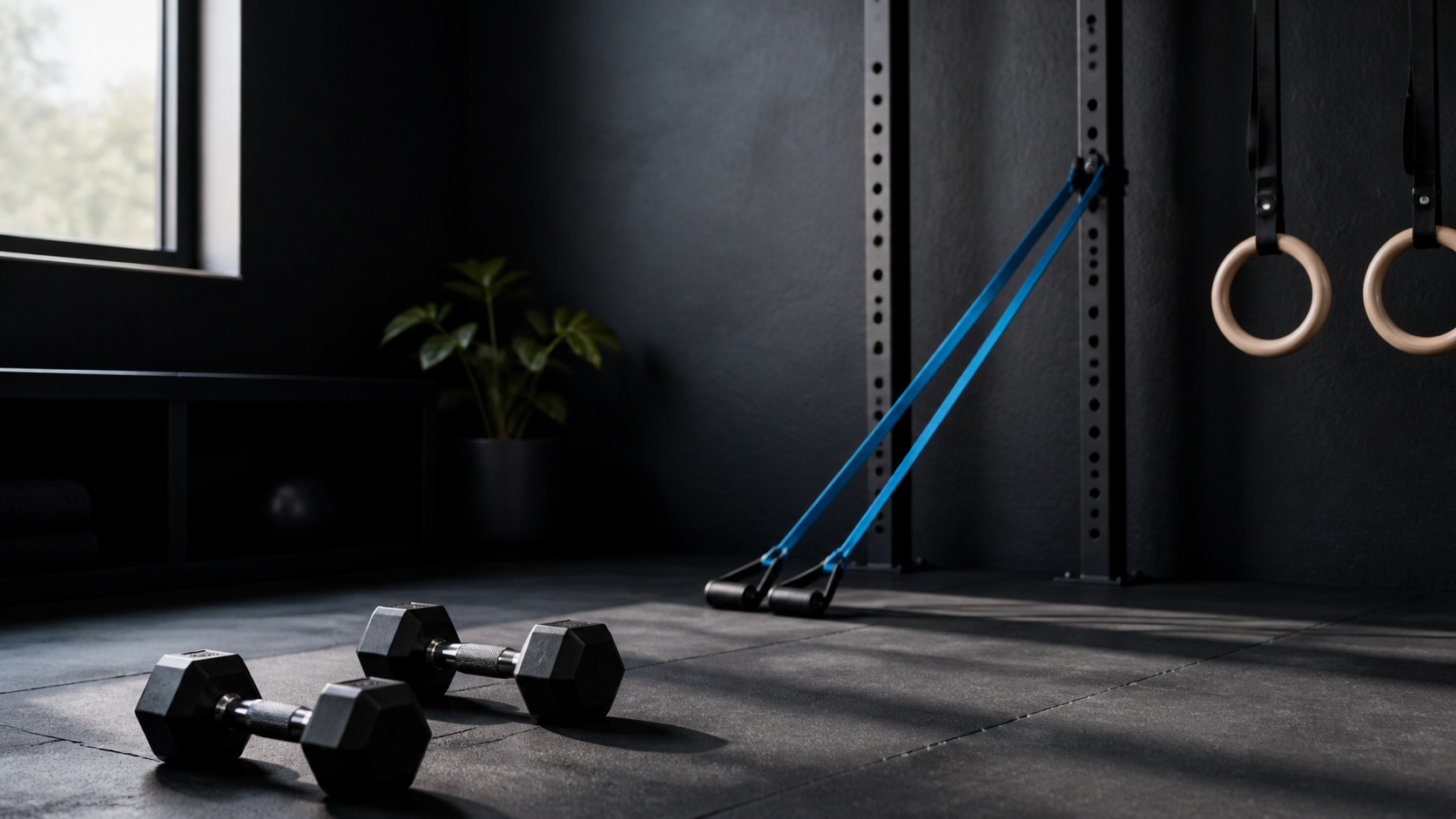
If you use bands, check them for damage and use a secure anchor. If you use rings, make sure the mounting point is genuinely designed to hold the load. Rings can be brilliant for experienced people, but they are not the automatic next purchase for a beginner who cannot yet perform stable push-ups or rows.
A simple limited-weight training framework
This is a general coaching framework, not an individual program.
Train the major movement patterns two or three times across the week:
- a squat or lunge;
- a hip hinge;
- an upper-body push;
- an upper-body pull; and
- one or two smaller movements that fit your goal.
Start with two working sets per exercise. Use a broad range of roughly 8–25 reps and finish most sets with about one to three good reps left. Rest long enough that the next set is limited by the target muscles, not only by your breathing.
When you reach the top of the rep range across your sets with the same technique and target effort, progress the exercise. Add a small amount of load if you can. If you cannot, choose one of the progression options above and begin building again.
For example:
- Week 1: floor push-up — 12 and 10 reps at about 2 reps in reserve.
- Week 2: floor push-up — 13 and 11 reps at about 2 reps in reserve.
- Week 3: floor push-up — 15 and 13 reps at about 2 reps in reserve.
- Week 4: add a light band safely, return to 10 and 9 reps, then build again.
That is progressive training. It is not random punishment and it is not exercise for the sake of being tired.
Good execution is not about looking perfect
Exercise technique matters because it gives you a standard.
If your week-one row is controlled but your week-four “personal best” involves twisting your torso and shortening the range, the extra reps may not represent the progress you think they do.
At the same time, there is no single perfect version of every exercise for every body. Limb lengths, training history, comfort, equipment and the muscle you want to train all affect the useful setup.
My preference is simple: choose a technique that is safe for your circumstances, suits the purpose of the exercise and can be repeated. Then work hard within that standard.
Execution without progression can become an excuse to stay comfortable. Progression without execution can become an excuse to count anything as a rep. You need both.
What if you lose some muscle during a break?
Do not panic and do not make promises you cannot support.
A long enough reduction in training can reduce muscle size and strength. How much you lose will depend on the length of the break, what activity you continue, your training history, nutrition and individual response.
The encouraging part is that previous progress is not necessarily gone forever. In a 2024 controlled trial, participants who took a ten-week break lost some strength and muscle size, then regained it rapidly when training resumed and finished with similar overall improvements to the continuous-training group.
That does not guarantee your exact timeline. It does mean a disrupted phase does not need to become an all-or-nothing disaster.
Maintain what you reasonably can. Improve your execution. Keep some structure in your week. Then rebuild when your circumstances allow it.
Training is only one part of muscle growth
The best set in the world cannot make up for a month of inconsistent training.
Muscle growth is also influenced by your total program, food intake, protein, sleep, stress, recovery and training history. You do not need to make every variable perfect, but the plan needs to be repeatable enough for your body to adapt.
Larger or faster physique outcomes normally ask for more work, precision and consistency. That trade-off is real. It still does not mean the most extreme option is the right one for your life.
Evidence-backed guidance versus my coaching preference
Here is the clean distinction.
The evidence supports:
- resistance training can increase muscle size across a range of loads and equipment types;
- heavier loads are more specific to maximal strength;
- training to absolute failure on every set is not required;
- higher weekly training volume can enhance hypertrophy; and
- progression can come from more reps as well as more load.
My practical KZPT starting point is:
- use repeatable technique and a controlled range;
- finish many working sets with about one to three good reps in reserve;
- use a simple rep range and record your work;
- progress one main variable at a time; and
- choose the version you can recover from and keep doing.
The first list describes what the research broadly supports. The second is how I turn that information into a workable starting point. Your experience, goal, health and equipment may require something different.
The takeaway
You do not need perfect equipment to build muscle. You need a resistance exercise that can challenge the right muscles, a standard you can repeat and a progression you can measure.
Use the equipment you have. Make the set honest. Keep the technique consistent. Then give yourself somewhere to go next week.
The tool matters far less than what you can reliably do with it.
Want a plan that works with the equipment you actually have?
Tell me where you train, what equipment you have and what you are trying to build. I will help you work out a sensible next step, without a generic sales pitch.
Research referenced
- American College of Sports Medicine Position Stand: Resistance Training Prescription for Muscle Function, Hypertrophy, and Physical Performance in Healthy Adults (opens in a new tab)
- Resistance Training Load Does Not Determine Resistance Training-Induced Hypertrophy Across Upper and Lower Limbs in Healthy Young Males (opens in a new tab)
- Similar Muscle Hypertrophy Following Eight Weeks of Resistance Training to Momentary Muscular Failure or With Repetitions-in-Reserve (opens in a new tab)
- Progressive Overload Without Progressing Load? The Effects of Load or Repetition Progression on Muscular Adaptations (opens in a new tab)
- Lengthened Partial Repetitions Elicit Similar Muscular Adaptations as Full Range of Motion Repetitions During Resistance Training in Trained Individuals (opens in a new tab)
- Does Taking a Break Matter? Adaptations in Muscle Strength and Size Between Continuous and Periodic Resistance Training (opens in a new tab)
General educational information only. Exercise should be adjusted to your experience, health and circumstances. Seek appropriate professional advice if you have pain, an injury, a medical condition or concerns about starting or changing your training.