
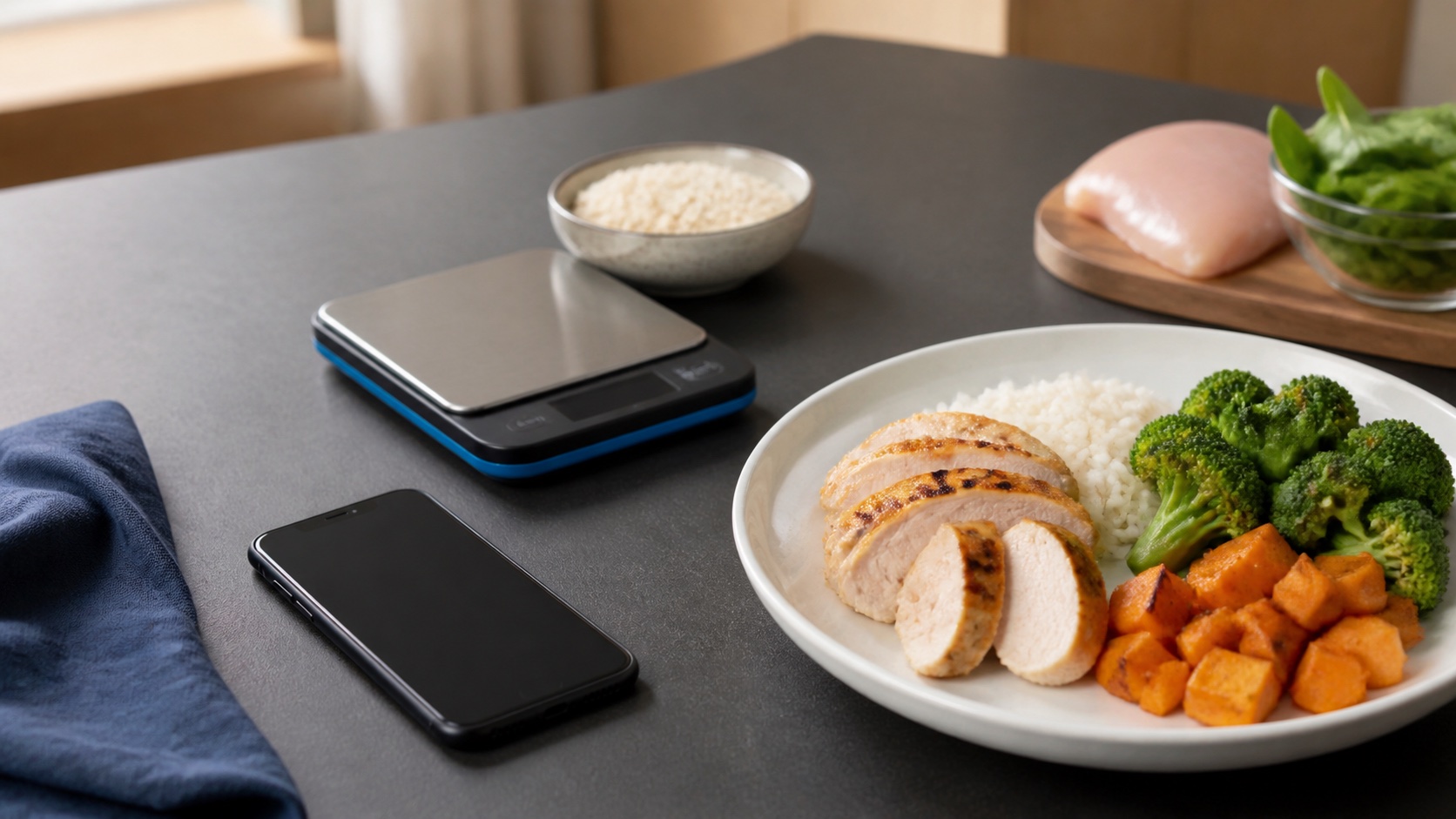
Macro tracking is meant to remove guesswork.
If it leaves you scared of eating out, frustrated because you finished seven grams over your carbohydrate target or convinced that one imperfect day has ruined the week, we have missed the point.
MyFitnessPal is a tool. Used well, it can show you what your normal portions actually contain, help you plan food you enjoy and teach you how to make small changes when fat loss stalls.
It does not measure your body perfectly. It does not make a food good or bad. And it cannot promise what you will weigh in five weeks.
The goal is simple: use the numbers to build more understanding and control, then decide how much tracking you genuinely need.
The quick answer
To track macros in MyFitnessPal:
- Set an appropriate calorie goal and a personalised protein target.
- Use carbohydrate and fat targets that suit your food preferences, training and health.
- Log the correct product and match the serving size you actually ate.
- Include the easy-to-miss extras such as oils, sauces, drinks and snacks.
- Plan tomorrow before it happens when you can.
- Save meals you repeat so tracking becomes quicker.
- Review the pattern over several weeks instead of judging one number or one day.
That is the practical process.
The harder part is knowing which numbers deserve your attention and when to stop chasing precision that no longer helps.
What matters most for fat loss?
For body fat to come down over time, average energy intake needs to remain below energy expenditure. That is the calorie deficit.
It does not mean calories are the only thing that matters. Protein, resistance training, food quality, fibre, sleep, stress, health and how well you can follow the plan all affect the result and the experience of getting there.
It does mean that eating at a special time or choosing a particular ratio of carbohydrates to fats will not rescue a plan that consistently supplies more energy than you need.
Research comparing healthy lower-fat and lower-carbohydrate diets has found meaningful individual variation, but no significant average difference in 12-month weight loss between the two approaches. A 12-month trial of calorie restriction with or without a restricted eating window also found that adding the eating window did not produce a statistically significant extra loss.
Meal timing can still help appetite, training, routine or a medical need. It just is not a compulsory fat-loss trick.
My practical order of attention is:
- Set a workable calorie target.
- Get protein into a useful range.
- Build most of the diet from nutritious foods you can repeat and enjoy.
- Adjust carbohydrates and fats to suit the person.
- Use meal timing where it makes the plan easier or supports training.
That order is a coaching framework, not a claim that vitamins, minerals or medical needs do not matter.
If the calorie deficit itself is still confusing, start with the KZPT Fat Loss Guide.
Before you watch: The video shows an older MyFitnessPal interface. This article reflects the product settings checked in August 2026.
Set MyFitnessPal up properly
The exact buttons can look different across iPhone, Android and MyFitnessPal's newer Today screen. In the current app, open Goals from the More/Menu area or your profile, then find Calorie & macro goals.
Before changing anything, remember that an app-generated target is an estimate. MyFitnessPal does not know your actual energy expenditure, training response, hunger, health history or whether the activity level you selected was realistic.
Use a target from your coach or dietitian if you have one. If you are setting your own, treat the first number as a starting estimate and review what happens over time.
What can the Free version do?
As of August 2026, MyFitnessPal lists these relevant features:
| Feature | Free | Premium |
|---|---|---|
| Log food and exercise | Yes | Yes |
| View calories and macronutrients | Yes | Yes |
| Customise calories and macro percentages | Yes | Yes |
| Create foods, meals and recipes | Yes | Yes |
| Set protein, carbs and fat in exact grams | No | Yes |
| Use the barcode scanner | No | Yes |
| Set different goals by day | No | Yes |
| Change how exercise calories affect the goal | No | Yes |
Free users can customise the macro split in five-percentage-point steps. Premium users can enter exact gram targets.
You do not need Premium to use the method in this article. It may reduce friction if the barcode scanner, exact grams or exercise-calorie controls are valuable to you. Features and pricing can change, so check the current MyFitnessPal plan comparison (opens in a new tab) before paying.
How should you set your macros?
Do not copy the 2,100-calorie day or the macro numbers from my video. They were an example for my body and my goal at that time.
For KZPT clients, I normally set calories and protein first. I commonly use a protein target around 2 grams per kilogram of body weight per day where that is appropriate, then adjust it for body size, training, diet, health, tolerance and the actual goal.
That is a deliberate higher-protein coaching preference. It is not a universal scientific minimum.
Research on resistance training has found that the average additional benefit to fat-free-mass gains tends to level off around 1.6 grams per kilogram per day in healthy adults who are not dieting, while some lean, resistance-trained people may benefit from higher intakes during a calorie deficit. Your useful target may be different.
Once protein is set, I use carbohydrates and fats to make the diet fit the person.
If you enjoy eggs, salmon, nuts, olive oil and fattier cuts of meat, you may prefer more room for fats. If rice, potato, oats, fruit and higher training volumes matter more to you, you may prefer more room for carbohydrates.
Neither choice gives you permission to force the other nutrient extremely low. It is about building a sensible diet you can follow, not winning a macro-ratio argument.
If you are pregnant, under 18, have a medical condition, take medication affected by food intake, have significant gastrointestinal concerns or need medical nutrition therapy, get individual advice from an appropriate health professional before changing your intake.
How to log food accurately: seven practical steps
1. Plan the day before you try to remember it
You can use MyFitnessPal as a diary at the end of the day. I prefer to use it as a plan.
Log tomorrow's breakfast, lunch, dinner and likely snacks tonight. You can then see a problem while it is still easy to solve.
If the planned day is low in protein, add a useful protein source. If dinner uses more calories than expected, change a portion or remove something you care about less. If you know you are buying lunch at work, put that in first and plan around it.
This is a coaching preference, not proof that everybody must pre-log. I like it because it turns tracking from an autopsy into a decision-making tool.
2. Do not assume the first search result is correct
In the video, I searched for a protein shake and the first similar-looking result had the wrong protein value. I had to compare the options with the bottle.
That still matters.
MyFitnessPal's check mark means the company has reviewed or added the entry and considers it accurate and complete. MyFitnessPal also says that even a checked entry can contain a mistake.
When the food has a label, compare:
- the product and flavour;
- energy per serving or per 100 grams;
- protein, carbohydrate and fat;
- the stated serving size; and
- whether the listing refers to the dry, raw, cooked or prepared food.
The check mark is useful. The label is still the final check.
3. Match the serving to what you actually ate
A correct food with the wrong serving is still a wrong log.
If the database entry is for 100 grams and you ate 150 grams, enter 1.5 servings. If the entry is for one large egg, make sure you did not eat two extra-large eggs and record one serving.
For foods that change weight during cooking, neither raw nor cooked is automatically the right answer. Use the entry that matches the state in which you weighed the food.
- Weighed raw chicken? Use a raw chicken entry.
- Weighed cooked potato? Use a cooked potato entry.
- Made a multi-ingredient meal? Build a recipe from the ingredients and divide it by the cooked yield or number of portions.
Consistency matters because water can be lost or absorbed during cooking. Raw and cooked weights are not interchangeable.
4. Include the extras that are easy to forget
People rarely forget the steak. They often forget what went around it.
Check for:
- cooking oil;
- dressings and sauces;
- milk or sugar in drinks;
- alcohol;
- spreads, nut butter and cheese;
- bites while cooking;
- snacks eaten from the packet; and
- a second serving that never made it into the diary.
This is not about assuming someone is lying when progress stalls. Food logging is genuinely difficult. Naturalistic research on MyFitnessPal has found omissions and portion-estimation problems even when people are trying to record accurately.
Start by checking the items most likely to move the total. Normal amounts of herbs and spices are rarely where the missing hundreds of calories are hiding.
5. Save repeat meals
Once you have checked a meal properly, save it to My Meals.
My breakfast might be eggs and a protein shake. Yours might be yoghurt, fruit and cereal. The point is not that one breakfast is better. The point is that the same ingredients and portions should not require fresh detective work every morning.
You can also save recipes and common combinations. This is one of the easiest ways to reduce the work without reducing the usefulness of tracking.
Just remember to update the saved meal when the brand, ingredient or portion changes.
6. Focus on calories and protein before chasing every gram
If your main goal is fat loss and your calories are close to target, your protein is in a useful range and the diet contains a reasonable mix of nutritious foods, being a few grams over fat or under carbohydrates is not a crisis.
The red and green numbers are not a report card.
Your target is better treated as a useful range than one exact dot. A physique athlete close to competition may need more precision because the expected result and deadline demand it. Most people trying to lose some body fat, get stronger and live a normal life do not need to behave like they are preparing to step on stage.
That does not mean “anything goes”. It means the level of precision should match the result you want and the life you are willing to live while pursuing it.
7. Review the trend and adjust one thing at a time
The diary only tells you what you entered. Your body-weight trend, training, hunger, energy, digestion and adherence tell you how the plan is working.
When weighing is appropriate and does not create distress, use measurements taken under similar conditions and look at weekly averages. Do not react to one morning after a salty meal, a hard session, a late dinner or a change in carbohydrate intake.
Give a reasonably consistent plan enough time to produce useful information. If the trend is not moving as expected, first check the quality of the log and how closely the plan was followed. Then adjust one main variable and review again.
Do not rewrite the entire diet every three days. You will never learn what worked.
A real example from the video: keep the sushi
In the original video, I built a day around foods I was already eating: eggs, a protein shake, a ready-made lunch, fruit, yoghurt, steak, potato and a couple of snacks.
The first version landed at roughly 1,900 calories against my 2,100-calorie target.
Then I added the sushi I often bought on a workday and the plan jumped above the target.
The old diet-plan response would be to say, “Sushi does not fit. Remove it.”
That was not my response.
I removed a duplicated protein shake and a snack, changed the sushi portion, checked the totals and added back one snack when it fitted. The exact foods and numbers are not important now. The decision process is.
I kept the food I genuinely wanted and changed the things I cared about less.
That is what MyFitnessPal is good for. It gives you a boundary, then lets you make choices inside it.
Freedom within constraints.
The example is not a meal plan for you and it is not a claim that sushi, protein bars or ready-made meals are required for fat loss. It is simply what I was eating in 2021 and a useful example of planning around real preferences.
How accurate is MyFitnessPal?
Accurate enough to be useful is not the same as perfectly accurate.
Validation research has found that MyFitnessPal can estimate energy and macronutrients reasonably well when the food matches are carefully selected. Other real-world research has found meaningful underestimation because people omit foods, struggle to match products and misjudge portions.
Both findings can be true.
The database is one source of error. Your portion, recipe, memory and consistency are others. Packaged-food labels and energy-expenditure estimates also have limits.
Use the app to create a repeatable estimate. Then compare that estimate with what happens over time.
If the diary says you are eating very little but your expected trend is not occurring, do not slash calories immediately and do not assume your body is broken. Check:
- whether all days were recorded;
- whether weekends were different;
- whether portions and serving units match;
- whether cooking oils, drinks and snacks were included;
- whether saved meals still match what you eat;
- whether the target already included your normal activity; and
- whether enough time has passed to judge a trend.
If intake is very low, symptoms are present or you are unsure what is safe, speak with an appropriate health professional.
Should you eat back exercise calories?
This is where the app and my normal coaching preference differ.
By default, MyFitnessPal uses net calories:
calories eaten − exercise calories = net calories
When exercise is added, the app may increase the amount available to eat so that the originally selected rate of change stays similar. MyFitnessPal describes that as intended behaviour. Premium users can change how exercise calories affect the goal.
For many general KZPT clients, I prefer a fixed daily target that already accounts for their normal training and activity. I do not automatically add every calorie reported by a watch back to the food budget.
There are two reasons:
- A fixed target is easier to understand and repeat.
- Wearable energy-expenditure estimates are not precise enough to treat as calories you have definitely “earned”. A 2025 systematic review found that Apple Watch energy-expenditure estimates exceeded a 10% error threshold across all analysed subgroups, even though heart-rate and step estimates performed better.
That is my coaching preference, not a universal rule.
If your target was deliberately set without exercise, your training load changes substantially, you do long endurance sessions or your performance, recovery and health are suffering, exercise energy needs cannot simply be ignored. The right response is to review the whole setup, not blindly obey or delete a watch number.
Do not take the five-week forecast literally
After you finish logging a day, MyFitnessPal may show an “If every day were like today” weight projection.
Even MyFitnessPal describes this as an estimate used for motivational purposes.
Every day will not be identical. Energy expenditure changes. Food entries and portions contain error. Scale weight moves with fluid, glycogen and food in the digestive system as well as changes in body tissue.
Look at the projection if you find it interesting. Do not build your confidence or your deadline around it.
Your real trend is more useful than the app's imaginary five perfect weeks.
Do you need to track every day forever?
No.
Detailed tracking is one way to learn. It is not the only way to make progress, and research does not show that everybody needs the same level of detail.
I use three broad approaches depending on the person and the goal:
A short calibration phase
Track accurately for roughly one to two weeks. Keep meals, training and activity reasonably consistent. Use the period to learn portions, expose missing extras and build a small library of repeat meals.
Full tracking during an active goal
Use more regular tracking when the goal, deadline and desired predictability justify it. A physique athlete will usually need more precision than someone who is happy with gradual general fat loss.
Repeat meals and lighter monitoring
Calculate a handful of common meals accurately, repeat the same ingredients and portions, then use body-weight, training and adherence trends to decide whether anything needs changing.
Some people do better with portion guides, meal structure or habit-based coaching instead of calorie tracking. That is not the “easy option”. It is a different tool.
The method has to give you enough information to make decisions without creating more burden than the result is worth.
When macro tracking is not helping
Stop and reassess if tracking is making you:
- anxious or guilty around normal meals;
- afraid to eat food you did not prepare;
- avoid social situations;
- compensate for food with restriction or exercise;
- label yourself as good or bad based on a diary total;
- repeatedly lower the target despite fatigue or other warning signs; or
- obsess over exact grams in a way that interferes with work, relationships or normal life.
Calorie tracking does not automatically mean someone has an eating disorder. Obsessive calorie counting, rigid rules and distress around food are recognised warning signs, though, and they deserve to be taken seriously.
If this sounds familiar, detailed tracking may not be the right tool for you. Speak with your GP or an eating-disorder-informed health professional. In Australia, Healthdirect (opens in a new tab) lists support options, and the Butterfly National Helpline (opens in a new tab) is available on 1800 ED HOPE (1800 33 4673).
Evidence-backed guidance versus my coaching preference
Here is the clean distinction.
| Evidence broadly supports | My practical KZPT preference |
|---|---|
| A sustained energy deficit drives fat loss over time. | Set a workable fixed calorie target, then review the real trend. |
| Different carbohydrate/fat distributions can support weight loss. | Set protein first, then use carbohydrates and fats to fit the person's food and training preferences. |
| Dietary self-monitoring can support weight-loss interventions, but engagement often declines. | Pre-log tomorrow and save repeat meals so tracking takes less effort. |
| Higher protein can support resistance-training adaptations, and needs can rise in some energy-restricted athletes. | Use approximately 2 g/kg/day where appropriate, as a higher coaching target rather than a universal minimum. |
| App entries, self-reported portions and wearable calorie estimates contain error. | Aim for consistent accuracy, not fake precision. |
| Detailed and simplified monitoring approaches can both be useful. | Match the amount of tracking to the goal, the person and the current phase of life. |
The evidence tells us what can work across groups. Coaching is the job of turning that into a sensible starting point for one person.
The takeaway
MyFitnessPal should teach you, not trap you.
Use it to understand portions. Use it to plan food you enjoy. Use it to see how a couple of small changes can bring a day back into range.
Get the big things right before worrying about the two-percenters. Be accurate enough to learn, but do not pretend the app is measuring your body in a laboratory.
Then keep only as much tracking as you need.
The end goal is not a perfect diary. It is knowing how to make informed choices when you want to lose body fat—and having a plan that still fits the rest of your life.
Want help turning the numbers into a plan you can actually follow?
Tell me where you are at, what you are trying to change and what keeps getting in the way. We can start with a straightforward conversation—no pressure and no generic sales pitch.
Research and product information referenced
- MyFitnessPal Free, Premium and Premium+ feature comparison (opens in a new tab)
- MyFitnessPal: Customise your nutritional goals (opens in a new tab)
- MyFitnessPal: What does the check mark mean? (opens in a new tab)
- MyFitnessPal: How the five-week projection works (opens in a new tab)
- Comparing Self-Monitoring Strategies for Weight Loss in a Smartphone App: Randomized Controlled Trial (opens in a new tab)
- A Pilot Randomized Trial of Simplified Versus Standard Calorie Dietary Self-Monitoring (opens in a new tab)
- Accuracy of Nutrient Calculations Using MyFitnessPal: Validation Study (opens in a new tab)
- The Use of a Food Logging App in the Naturalistic Setting (opens in a new tab)
- Effect of Low-Fat vs Low-Carbohydrate Diet on 12-Month Weight Loss: DIETFITS (opens in a new tab)
- Calorie Restriction With or Without Time-Restricted Eating in Weight Loss (opens in a new tab)
- Protein Supplementation and Resistance Training: Systematic Review and Meta-analysis (opens in a new tab)
- Dietary Protein During Caloric Restriction in Resistance-trained Lean Athletes: Systematic Review (opens in a new tab)
- Apple Watch Accuracy in Monitoring Health Metrics: Systematic Review and Meta-analysis (opens in a new tab)
- Australian Dietary Guidelines (opens in a new tab)
General educational information only. It is not medical or individual dietetic advice. Calorie and macro targets should be adjusted to the person's goal, health, training, food preferences and circumstances. Seek advice from an appropriate health professional for medical conditions, pregnancy, eating-disorder concerns or other needs outside general fitness coaching.